
Cyber Security with Crypto
Estimating Q-Day – When quantum breaks crypto
Book a free of cost consultation with our modern BI experts today
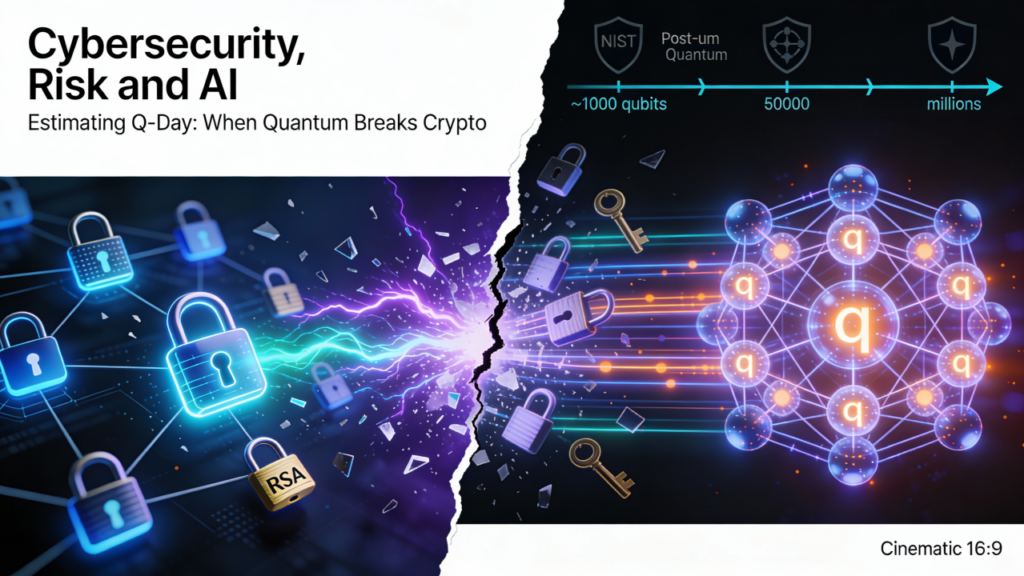
Q‑day is the name given to the future moment when a “cryptographically relevant” quantum computer becomes powerful and stable enough to break today’s public‑key encryption schemes like RSA and elliptic‑curve cryptography in practical time using algorithms such as Shor’s. It is not a specific calendar date but a capability threshold, marking the point at which the public‑key foundations of HTTPS, VPNs, digital signatures, and many cryptocurrencies could be silently undermined, while symmetric ciphers like AES mainly require longer keys to remain safe. In practice, Q‑day will likely only be recognized in hindsight, through a combination of public breakthroughs and unexplained compromises, which is why standards bodies and large enterprises are already planning “crypto‑agile” migrations to post‑quantum algorithms before that day arrives.
Quantum computers will almost certainly break today’s public‑key cryptography if they keep improving, but that requires machines with millions of physical qubits and full error correction, not the thousand‑qubit noisy devices we have today. For CISOs and architects, the rational stance is simple: treat “Q‑day” as a when‑not‑if risk over the next few decades and migrate long‑lived data and protocols to post‑quantum schemes now, instead of betting on hype or pessimism.
Where Quantum Computers Really Are
Vendors have made real hardware progress since 2020, scaling from a few dozen to around a thousand noisy qubits on state‑of‑the‑art superconducting and trapped‑ion devices. These systems can demonstrate quantum “utility” on specialized problems, but they are not fault‑tolerant and cannot run long algorithms like Shor’s at meaningful scales.
Key realities today:
- Qubits: Leading platforms advertise chips in the low‑hundreds to around a thousand physical qubits, with error rates far too high for deep cryptanalytic circuits.
- Error correction: No full‑scale logical qubits (with continuous error correction) at the scale needed for cryptographic attacks have been demonstrated.
- Use cases: The most promising near‑term wins are in quantum simulation and specialized optimization, not general “super‑computing everything.”
This aligns with the Cambridge‑trained YouTuber’s assessment (https://www.youtube.com/watch?v=pDj1QhPOVBo&t=404s): hardware roadmaps are impressive and roughly on track, but algorithmic progress for new, broadly useful problems has been slower and more disappointing than early optimism suggested.
What “Breaking Cryptography” Really Means
When security people talk about “Q‑day,” they usually mean a quantum computer that can run Shor’s algorithm to break real‑world RSA and ECC in practical time. That is very different from toy demonstrations factoring 15 or 21 on a lab device.
In operational terms, “breaking cryptography” means:
- Factor a 2048‑bit RSA modulus or solve a P‑256 / X25519 discrete log fast enough to undermine TLS, VPNs, and code‑signing in minutes to hours.
- Do this reliably enough that it is usable in real attack campaigns, not just a single heroic lab experiment.
Symmetric crypto like AES is impacted only quadratically via Grover’s algorithm, so AES‑256 remains acceptable in post‑quantum guidance while public‑key schemes are the main casualty.
How Many Qubits to Break RSA/ECC?
Shor’s algorithm needs logical qubits, which are error‑corrected qubits built from many noisy physical qubits. Resource‑estimation papers differ in details, but they land in the same ballpark:
- Logical vs physical: One logical qubit typically costs on the order of 10310^3103 to 10410^4104 physical qubits, depending on hardware error rates and the error‑correcting code.
- RSA‑2048: Published estimates for a practical Shor attack require thousands to tens of thousands of logical qubits and roughly 101110^{11}1011–101310^{13}1013 logical gate operations, mapping to about 5–20 million physical qubits in optimistic scenarios, and potentially 100+ million with less favorable assumptions.
- ECC (P‑256 / X25519): Similar complexity class as RSA in practice; still in the “thousands of logical qubits, multi‑million physical qubits” range.
- AES‑128/256: Grover‑style attacks would need far fewer logical qubits but astronomically many operations; AES‑256 is still considered safe given sensible parameters.
Short version for your readers:
- Today: ~10³ noisy qubits.
- Cryptography‑breaking Shor box: ~10⁶–10⁸ physical qubits plus robust error correction and long coherent runtimes.
We are multiple qualitative jumps away, not a single product cycle.
When Could a Million‑Qubit Machine Arrive?
Estimating Q‑day means extrapolating hardware and error‑correction progress, then layering on realistic cryptanalytic workloads. Even experts disagree, but some robust themes emerge:
- Hardware scaling: Major players (IBM, Google, others) have public roadmaps that project thousands, then tens of thousands of qubits in the 2030s, assuming continued improvements in fabrication, control electronics, and cryogenics.
- Utility vs advantage: Vendors talk about “quantum utility” and “quantum advantage” on niche problems in the second half of this decade, not “RSA is dead next year.”
- Algorithmic bottlenecks: As the ex‑quantum‑computing researcher emphasizes, the real constraint is not just building bigger chips; it is having enough high‑value algorithms where quantum truly dominates, beyond factoring and a few structured problems.
Her core points :
- Quantum computers are not magic general‑purpose supercomputers; they excel only on specific structured problems with carefully crafted algorithms.
- Algorithm discovery has been slower than early hype, especially in areas like quantum machine learning and generic chemistry speedups.
- Hardware may reach impressive scales in 10–20 years, but “fully functioning” does not automatically mean “cryptography‑killer” without the corresponding algorithmic and error‑correction maturity.
Reasonable, defense‑oriented forecast:
- Substantial risk that a nation‑state–scale adversary could operate a crypto‑breaking quantum system sometime between the late‑2030s and 2050s.
- Non‑zero risk earlier if there are unexpected breakthroughs, which is exactly why NIST, ETSI, and others are standardizing post‑quantum schemes now.
For governance, you do not need to guess the exact year. You need to compare that range to the confidentiality lifetime of your data.
CISO Lens: Estimating and Acting on Q‑Day
From a Cybersecurity, Risk and AI perspective, the right frame for Q‑day is not prediction, but hazard times lifetime:
- If a dataset must stay confidential for 2–3 years (e.g., some operational logs), Q‑day in 2040 is irrelevant.
- If it must stay confidential for 10–30+ years (health records, state secrets, long‑term IP, M&A, diplomatic archives), then harvest‑now‑decrypt‑later becomes a credible threat.
Practical guidance you can give your readers:
- Treat Q‑day as “high impact, uncertain timing.” Do not wait for a newspaper headline to start migration.
- Plan for attackers with ~10⁴–10⁵ logical qubits and ~10⁶–10⁸ physical qubits, plus competent software and error‑correction stacks, even though that world does not exist yet.
- Follow NIST PQC and similar standards bodies for key encapsulation and signatures, and prioritize hybrid deployments (classical + PQC) on high‑value systems.
In other words, use today’s imperfect but real quantum progress as a forcing function to modernize your cryptography and key‑management practices, instead of obsessing over whether Q‑day is in 2038 or 2047.